
'%3e%3cpath%20d='M21.97,16.783C18.592,14.338%2014.595,14.954%2012,17.1C11.344,16.628%2010.011,15.91%209.895,15.621C9.48,14.59%207.341,14.568%207.01,14.882C6.812,15.07%206.83,15.344%206.553,15.331C4.832,15.252%203.708,15.794%201.993,16.774'%20style='fill:none;fill-rule:nonzero;stroke:%2310b981;stroke-width:1.14px;'/%3e%3c/g%3e%3cg%20transform='matrix(1,0,0,2.04091,-14.1682,-22.4853)'%3e%3cpath%20d='M15.074,18.836L15.074,17.423'%20style='fill:none;stroke:%2310b981;stroke-width:0.62px;stroke-linecap:square;stroke-miterlimit:1.5;'/%3e%3c/g%3e%3cg%20transform='matrix(1,0,0,2.04091,6.00754,-22.5274)'%3e%3cpath%20d='M15.074,18.863L15.074,17.423'%20style='fill:none;stroke:%2310b981;stroke-width:0.62px;stroke-linecap:square;stroke-miterlimit:1.5;'/%3e%3c/g%3e%3cg%20transform='matrix(1,0,0,1.10679,-1,-3.20585)'%3e%3cpath%20d='M2,5.5C5.5,3.5%209.5,4%2012,5.8C14.5,4%2018.5,3.5%2022,5.5L22,16.8C18.5,14.8%2014.5,15.3%2012,17.1C9.5,15.3%205.5,14.8%202,16.8L2,5.5Z'%20style='fill:none;fill-rule:nonzero;stroke:%236ee7b7;stroke-width:1.14px;'/%3e%3c/g%3e%3cg%20transform='matrix(1,0,0,1.026,-1,-2.90714)'%3e%3cpath%20d='M12,5.8L12,17.1'%20style='fill:none;fill-rule:nonzero;stroke:%236ee7b7;stroke-width:1.2px;'/%3e%3c/g%3e%3cg%20transform='matrix(0.868549,0,0,1.12022,1.58071,-2.86274)'%3e%3cpath%20d='M8,15.6L8,19.8L6.5,18.5L5,19.8L5,15.6'%20style='fill:none;fill-rule:nonzero;stroke:%236ee7b7;stroke-width:1.2px;'/%3e%3c/g%3e%3cg%20transform='matrix(1,0,0,1,-1,-3.75633)'%3e%3cpath%20d='M5,9C6.467,8.4%207.967,8.5%209.5,9.3'%20style='fill:none;fill-rule:nonzero;stroke:%236ee7b7;stroke-width:1.2px;'/%3e%3c/g%3e%3cg%20transform='matrix(1,0,0,1,-1,-3.75633)'%3e%3cpath%20d='M5,12C6.333,11.467%208.119,11.635%209.119,12.235'%20style='fill:none;fill-rule:nonzero;stroke:%236ee7b7;stroke-width:1.2px;'/%3e%3c/g%3e%3cg%20transform='matrix(0.988254,-0.152823,0.152823,0.988254,6.85356,-2.53705)'%3e%3cpath%20d='M5,12C6.333,11.467%208.119,11.635%209.119,12.235'%20style='fill:none;fill-rule:nonzero;stroke:%236ee7b7;stroke-width:1.2px;'/%3e%3c/g%3e%3cg%20transform='matrix(1,0,0,1,-1,-3.75633)'%3e%3cpath%20d='M14.5,9.3C16.033,8.5%2017.533,8.4%2019,9'%20style='fill:none;fill-rule:nonzero;stroke:%236ee7b7;stroke-width:1.2px;'/%3e%3c/g%3e%3cg%20transform='matrix(1,0,0,1,-1,2.24367)'%3e%3cpath%20d='M5,9C6.467,8.4%207.967,8.5%209.5,9.3'%20style='fill:none;fill-rule:nonzero;stroke:%236ee7b7;stroke-width:1.2px;'/%3e%3c/g%3e%3cg%20transform='matrix(0.999988,0.00496871,-0.00496871,0.999988,-0.955288,2.16055)'%3e%3cpath%20d='M14.5,9.3C16.033,8.5%2017.533,8.4%2019,9'%20style='fill:none;fill-rule:nonzero;stroke:%236ee7b7;stroke-width:1.2px;'/%3e%3c/g%3e%3c/svg%3e)
Explanation
In a minority attack, two pawns may advance against three enemy pawns, or another smaller group attacks a larger one on the same side of the board. The usual purpose is not to win by numbers or attack the king. The aim is to force exchanges that leave an isolated pawn, with no friendly pawn on a neighboring file, a backward pawn, which cannot advance safely beside its neighbors, or another hard-to-defend target. The advance may also open a file, meaning a vertical line, for the pieces.
A common pattern is to advance the leading pawn until it contacts the enemy majority. If the opponent captures, the recapture may open a line; if the exchange is allowed, one enemy pawn may become fixed as a target. The final pawn arrangement must be judged after the exchanges, not by the aggressive appearance of the advance.
The minority changes the lines


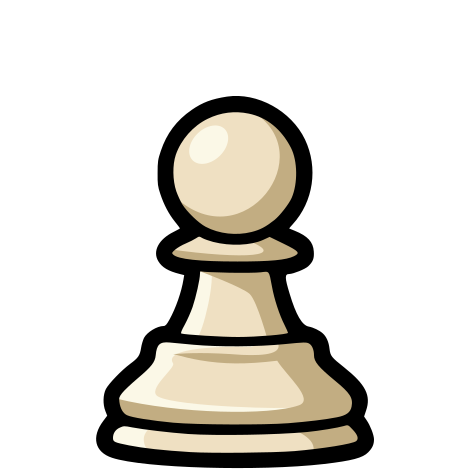
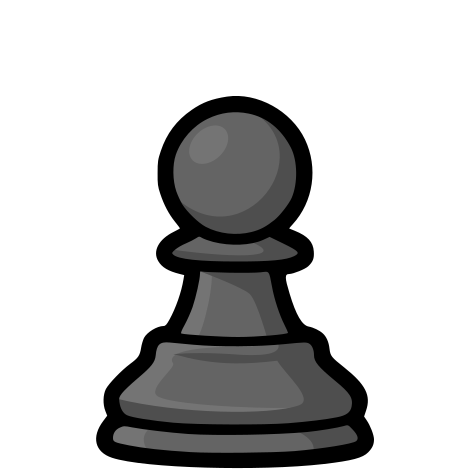
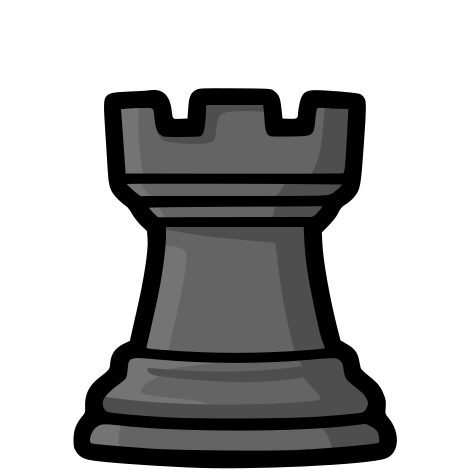

Before contact
White has two pawns, and , against three black pawns, , , and , on the queenside. The rooks on and could use files that later exchanges may clear.
Conditions that make the plan work
- The final pawn arrangement creates a weaker target than the attacker's advanced pawns.
- The opponent does not gain a faster attack against the king or center.
- The pieces, especially rooks, can use the lines that will open.
- The advance does not split the attacker's pawns into too many , groups separated by files containing no friendly pawns.
The plan can be slow. The defender may strike first with a pawn advance that opens lines, move the pawn that was going to become weak, block the advance, or create active threats on the other side of the board. A minority attack is therefore not an automatic opening recipe but a change in the pawn arrangement that must be compared with both sides' available activity.
Common confusions
Minority attack and king attack
The word attack describes the collision between pawn groups. The normal goal is a lasting weakness in the enemy pawns, not an immediate checkmate.
Pawn minority and pawn majority
A majority often advances to create a passed pawn. A minority advances into more pawns to alter and weaken the enemy pawn arrangement.
Sources
- 1.Minority Attack, Chess.com
- 2.Minority attack, Wikipedia
- 3.The Winning Academy 28: How to Defend Against a Minority Attack?, ChessBase