
'%3e%3cpath%20d='M21.97,16.783C18.592,14.338%2014.595,14.954%2012,17.1C11.344,16.628%2010.011,15.91%209.895,15.621C9.48,14.59%207.341,14.568%207.01,14.882C6.812,15.07%206.83,15.344%206.553,15.331C4.832,15.252%203.708,15.794%201.993,16.774'%20style='fill:none;fill-rule:nonzero;stroke:%2310b981;stroke-width:1.14px;'/%3e%3c/g%3e%3cg%20transform='matrix(1,0,0,2.04091,-14.1682,-22.4853)'%3e%3cpath%20d='M15.074,18.836L15.074,17.423'%20style='fill:none;stroke:%2310b981;stroke-width:0.62px;stroke-linecap:square;stroke-miterlimit:1.5;'/%3e%3c/g%3e%3cg%20transform='matrix(1,0,0,2.04091,6.00754,-22.5274)'%3e%3cpath%20d='M15.074,18.863L15.074,17.423'%20style='fill:none;stroke:%2310b981;stroke-width:0.62px;stroke-linecap:square;stroke-miterlimit:1.5;'/%3e%3c/g%3e%3cg%20transform='matrix(1,0,0,1.10679,-1,-3.20585)'%3e%3cpath%20d='M2,5.5C5.5,3.5%209.5,4%2012,5.8C14.5,4%2018.5,3.5%2022,5.5L22,16.8C18.5,14.8%2014.5,15.3%2012,17.1C9.5,15.3%205.5,14.8%202,16.8L2,5.5Z'%20style='fill:none;fill-rule:nonzero;stroke:%236ee7b7;stroke-width:1.14px;'/%3e%3c/g%3e%3cg%20transform='matrix(1,0,0,1.026,-1,-2.90714)'%3e%3cpath%20d='M12,5.8L12,17.1'%20style='fill:none;fill-rule:nonzero;stroke:%236ee7b7;stroke-width:1.2px;'/%3e%3c/g%3e%3cg%20transform='matrix(0.868549,0,0,1.12022,1.58071,-2.86274)'%3e%3cpath%20d='M8,15.6L8,19.8L6.5,18.5L5,19.8L5,15.6'%20style='fill:none;fill-rule:nonzero;stroke:%236ee7b7;stroke-width:1.2px;'/%3e%3c/g%3e%3cg%20transform='matrix(1,0,0,1,-1,-3.75633)'%3e%3cpath%20d='M5,9C6.467,8.4%207.967,8.5%209.5,9.3'%20style='fill:none;fill-rule:nonzero;stroke:%236ee7b7;stroke-width:1.2px;'/%3e%3c/g%3e%3cg%20transform='matrix(1,0,0,1,-1,-3.75633)'%3e%3cpath%20d='M5,12C6.333,11.467%208.119,11.635%209.119,12.235'%20style='fill:none;fill-rule:nonzero;stroke:%236ee7b7;stroke-width:1.2px;'/%3e%3c/g%3e%3cg%20transform='matrix(0.988254,-0.152823,0.152823,0.988254,6.85356,-2.53705)'%3e%3cpath%20d='M5,12C6.333,11.467%208.119,11.635%209.119,12.235'%20style='fill:none;fill-rule:nonzero;stroke:%236ee7b7;stroke-width:1.2px;'/%3e%3c/g%3e%3cg%20transform='matrix(1,0,0,1,-1,-3.75633)'%3e%3cpath%20d='M14.5,9.3C16.033,8.5%2017.533,8.4%2019,9'%20style='fill:none;fill-rule:nonzero;stroke:%236ee7b7;stroke-width:1.2px;'/%3e%3c/g%3e%3cg%20transform='matrix(1,0,0,1,-1,2.24367)'%3e%3cpath%20d='M5,9C6.467,8.4%207.967,8.5%209.5,9.3'%20style='fill:none;fill-rule:nonzero;stroke:%236ee7b7;stroke-width:1.2px;'/%3e%3c/g%3e%3cg%20transform='matrix(0.999988,0.00496871,-0.00496871,0.999988,-0.955288,2.16055)'%3e%3cpath%20d='M14.5,9.3C16.033,8.5%2017.533,8.4%2019,9'%20style='fill:none;fill-rule:nonzero;stroke:%236ee7b7;stroke-width:1.2px;'/%3e%3c/g%3e%3c/svg%3e)
Explanation
In this ending, one side has a king, knight, and pawn, while the other has a king and bishop. There is no automatic result. King placement, the pawn's route, the color of squares controlled by the bishop, and whose turn it is may decide between a win and a draw.
The bishop is a long-range defender. Its simplest plan is to hold a diagonal that the pawn must cross. If the defending king stands in front of the pawn or arrives close enough, the attacker may not have time to drive it away. The knight can temporarily block a diagonal or attack the bishop, but it usually cannot perform every necessary task at once while also helping the pawn advance.
A reserve route to


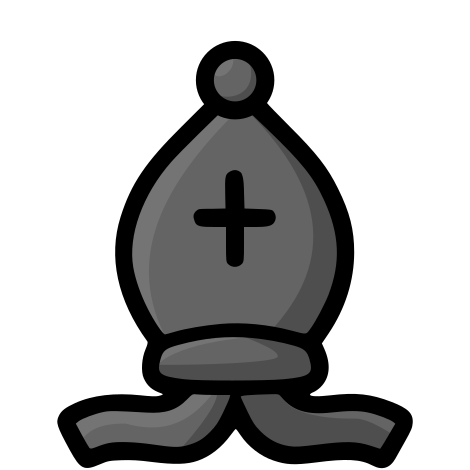
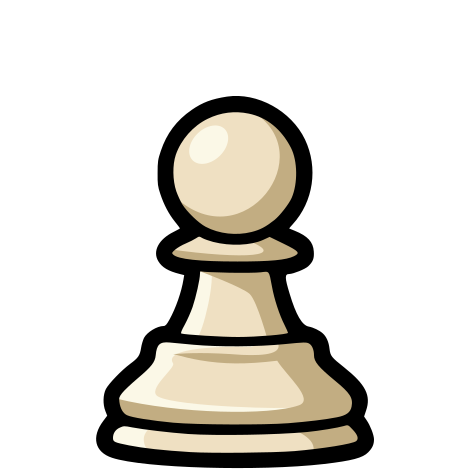

The bishop retains anchor squares
The pawn on must cross . The bishop on controls that square and can relocate to or while retaining its relation to , as the black king on supports the blockade.
The attacker needs coordination. The king must gain space, the knight must remove useful bishop squares, and the pawn should advance only when the bishop cannot give itself up for it. Sometimes the knight closes the decisive diagonal. In other positions, chasing the bishop costs enough moves for the defending king to establish a blockade.
The knight cuts the diagonal
blocks access to
The white knight on interrupts the -- line and is protected by the king on . The king also controls , leaving the bishop with fewer useful routes. The move is best and preserves a winning advantage.
How to evaluate it
- Identify the square the pawn must cross and the diagonals from which the bishop can keep controlling it.
- Check whether the defending king can stand in front of the pawn or arrive close enough to maintain the blockade.
- Count the moves needed by the attacking king and knight to drive the bishop away without allowing it to capture the pawn.
Usage and context
Endgame tablebases can give the exact result of a concrete position with this material, while the human explanation still revolves around the blockade, move order, and coordination.
Common confusions
The knight can always block the diagonal
It may close one line, but the bishop often has another square or diagonal, and the move can be decisive.
An extra pawn must win
The bishop and king may build a blockade that the knight cannot break.
Sources
- 1.Chess endgame, Wikipedia contributors
- 2.Endgame tablebase, Wikipedia contributors
- 3.Carlsen, Dubov and So showcase their endgame prowess, ChessBase