
'%3e%3cpath%20d='M21.97,16.783C18.592,14.338%2014.595,14.954%2012,17.1C11.344,16.628%2010.011,15.91%209.895,15.621C9.48,14.59%207.341,14.568%207.01,14.882C6.812,15.07%206.83,15.344%206.553,15.331C4.832,15.252%203.708,15.794%201.993,16.774'%20style='fill:none;fill-rule:nonzero;stroke:%2310b981;stroke-width:1.14px;'/%3e%3c/g%3e%3cg%20transform='matrix(1,0,0,2.04091,-14.1682,-22.4853)'%3e%3cpath%20d='M15.074,18.836L15.074,17.423'%20style='fill:none;stroke:%2310b981;stroke-width:0.62px;stroke-linecap:square;stroke-miterlimit:1.5;'/%3e%3c/g%3e%3cg%20transform='matrix(1,0,0,2.04091,6.00754,-22.5274)'%3e%3cpath%20d='M15.074,18.863L15.074,17.423'%20style='fill:none;stroke:%2310b981;stroke-width:0.62px;stroke-linecap:square;stroke-miterlimit:1.5;'/%3e%3c/g%3e%3cg%20transform='matrix(1,0,0,1.10679,-1,-3.20585)'%3e%3cpath%20d='M2,5.5C5.5,3.5%209.5,4%2012,5.8C14.5,4%2018.5,3.5%2022,5.5L22,16.8C18.5,14.8%2014.5,15.3%2012,17.1C9.5,15.3%205.5,14.8%202,16.8L2,5.5Z'%20style='fill:none;fill-rule:nonzero;stroke:%236ee7b7;stroke-width:1.14px;'/%3e%3c/g%3e%3cg%20transform='matrix(1,0,0,1.026,-1,-2.90714)'%3e%3cpath%20d='M12,5.8L12,17.1'%20style='fill:none;fill-rule:nonzero;stroke:%236ee7b7;stroke-width:1.2px;'/%3e%3c/g%3e%3cg%20transform='matrix(0.868549,0,0,1.12022,1.58071,-2.86274)'%3e%3cpath%20d='M8,15.6L8,19.8L6.5,18.5L5,19.8L5,15.6'%20style='fill:none;fill-rule:nonzero;stroke:%236ee7b7;stroke-width:1.2px;'/%3e%3c/g%3e%3cg%20transform='matrix(1,0,0,1,-1,-3.75633)'%3e%3cpath%20d='M5,9C6.467,8.4%207.967,8.5%209.5,9.3'%20style='fill:none;fill-rule:nonzero;stroke:%236ee7b7;stroke-width:1.2px;'/%3e%3c/g%3e%3cg%20transform='matrix(1,0,0,1,-1,-3.75633)'%3e%3cpath%20d='M5,12C6.333,11.467%208.119,11.635%209.119,12.235'%20style='fill:none;fill-rule:nonzero;stroke:%236ee7b7;stroke-width:1.2px;'/%3e%3c/g%3e%3cg%20transform='matrix(0.988254,-0.152823,0.152823,0.988254,6.85356,-2.53705)'%3e%3cpath%20d='M5,12C6.333,11.467%208.119,11.635%209.119,12.235'%20style='fill:none;fill-rule:nonzero;stroke:%236ee7b7;stroke-width:1.2px;'/%3e%3c/g%3e%3cg%20transform='matrix(1,0,0,1,-1,-3.75633)'%3e%3cpath%20d='M14.5,9.3C16.033,8.5%2017.533,8.4%2019,9'%20style='fill:none;fill-rule:nonzero;stroke:%236ee7b7;stroke-width:1.2px;'/%3e%3c/g%3e%3cg%20transform='matrix(1,0,0,1,-1,2.24367)'%3e%3cpath%20d='M5,9C6.467,8.4%207.967,8.5%209.5,9.3'%20style='fill:none;fill-rule:nonzero;stroke:%236ee7b7;stroke-width:1.2px;'/%3e%3c/g%3e%3cg%20transform='matrix(0.999988,0.00496871,-0.00496871,0.999988,-0.955288,2.16055)'%3e%3cpath%20d='M14.5,9.3C16.033,8.5%2017.533,8.4%2019,9'%20style='fill:none;fill-rule:nonzero;stroke:%236ee7b7;stroke-width:1.2px;'/%3e%3c/g%3e%3c/svg%3e)
Explanation
Opposite-side castling occurs when one player castles toward the kingside and the other toward the queenside. A wing is one side of the board. is the special move in which the king moves two squares toward a rook and that rook crosses to the king's other side. Kingside castling is also called short castling, and queenside castling is called long castling.
The structure often encourages fast attacks because the pawns advancing toward the enemy king are far from the attacker's own king. Each side may launch a , a coordinated series of advances that controls more territory, drives pieces away, and opens files or diagonals. This often creates a race in which the first check, a direct attack on the king that requires a response, or another forcing threat matters more than general progress.
The strategic rule is not to attack without calculation. The middle of the board may open before either wing attack arrives, a queen may enter by another route, and pieces need squares from which to support the pawns. Speed depends on how many moves each advance requires. It also depends on the available pawn breaks, meaning advances or captures that change the pawn arrangement and open lines, and on how easily each can be opened.
Two wings and a competing center
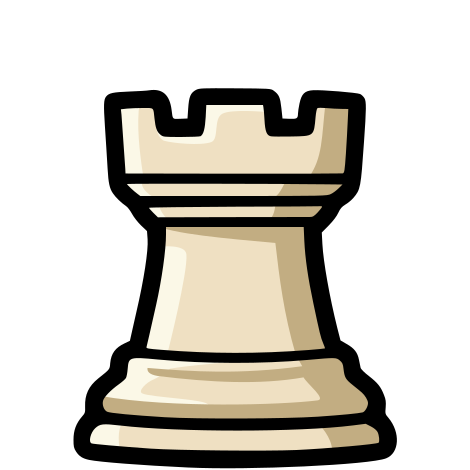

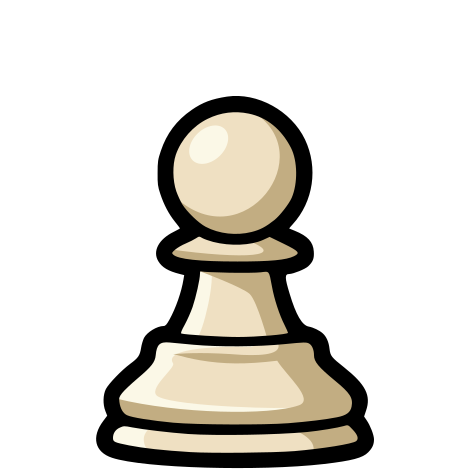
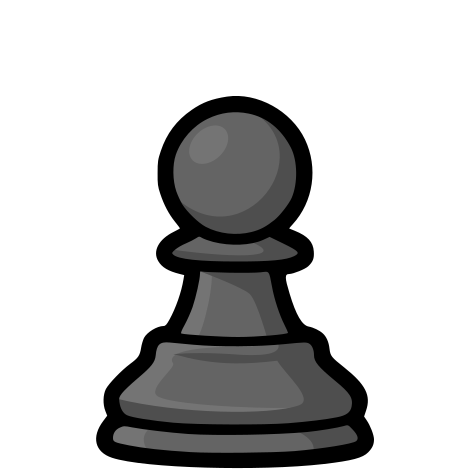

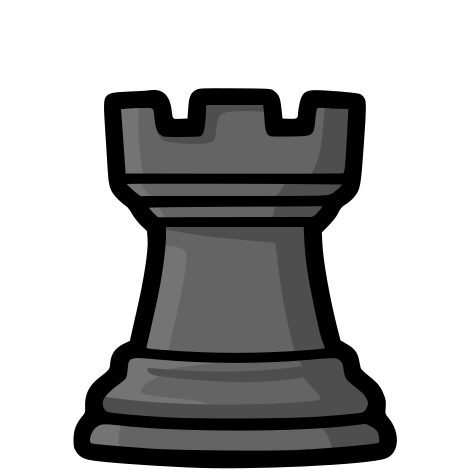
Three routes before choosing
White can prepare against , while Black can prepare against the white shield. The tension on and may open the center first, so neither wing advance is compulsory.
What decides the race
- The distance between the attacking pawns and the enemy king.
- How many pieces can join with tempo, meaning while creating an immediate threat.
- The checks and captures that force the opponent to respond.
- The state of the center, because a castled king can still be exposed through central lines.
Compared with , advancing pawns toward the enemy king usually costs less safety at home. Even so, a queen trade, a closed wing, or active central threats that force a response may make the attacking race unnecessary.
Common confusions
Not a special chess variant
Opposite-side castling only describes where the kings finished. The rules of chess and castling remain unchanged.
An attack is not compulsory
The placement of the kings and pawns often invites an attack, but a queen trade, an open center, or an advantage in pawns or pieces may make another plan better.
Sources
- 1.FIDE Laws of Chess taking effect from 1 January 2023, FIDE
- 2.Castling, Chess.com
- 3.Opposite Side Castling: The Basics, Part 2, Chess.com