
'%3e%3cpath%20d='M21.97,16.783C18.592,14.338%2014.595,14.954%2012,17.1C11.344,16.628%2010.011,15.91%209.895,15.621C9.48,14.59%207.341,14.568%207.01,14.882C6.812,15.07%206.83,15.344%206.553,15.331C4.832,15.252%203.708,15.794%201.993,16.774'%20style='fill:none;fill-rule:nonzero;stroke:%2310b981;stroke-width:1.14px;'/%3e%3c/g%3e%3cg%20transform='matrix(1,0,0,2.04091,-14.1682,-22.4853)'%3e%3cpath%20d='M15.074,18.836L15.074,17.423'%20style='fill:none;stroke:%2310b981;stroke-width:0.62px;stroke-linecap:square;stroke-miterlimit:1.5;'/%3e%3c/g%3e%3cg%20transform='matrix(1,0,0,2.04091,6.00754,-22.5274)'%3e%3cpath%20d='M15.074,18.863L15.074,17.423'%20style='fill:none;stroke:%2310b981;stroke-width:0.62px;stroke-linecap:square;stroke-miterlimit:1.5;'/%3e%3c/g%3e%3cg%20transform='matrix(1,0,0,1.10679,-1,-3.20585)'%3e%3cpath%20d='M2,5.5C5.5,3.5%209.5,4%2012,5.8C14.5,4%2018.5,3.5%2022,5.5L22,16.8C18.5,14.8%2014.5,15.3%2012,17.1C9.5,15.3%205.5,14.8%202,16.8L2,5.5Z'%20style='fill:none;fill-rule:nonzero;stroke:%236ee7b7;stroke-width:1.14px;'/%3e%3c/g%3e%3cg%20transform='matrix(1,0,0,1.026,-1,-2.90714)'%3e%3cpath%20d='M12,5.8L12,17.1'%20style='fill:none;fill-rule:nonzero;stroke:%236ee7b7;stroke-width:1.2px;'/%3e%3c/g%3e%3cg%20transform='matrix(0.868549,0,0,1.12022,1.58071,-2.86274)'%3e%3cpath%20d='M8,15.6L8,19.8L6.5,18.5L5,19.8L5,15.6'%20style='fill:none;fill-rule:nonzero;stroke:%236ee7b7;stroke-width:1.2px;'/%3e%3c/g%3e%3cg%20transform='matrix(1,0,0,1,-1,-3.75633)'%3e%3cpath%20d='M5,9C6.467,8.4%207.967,8.5%209.5,9.3'%20style='fill:none;fill-rule:nonzero;stroke:%236ee7b7;stroke-width:1.2px;'/%3e%3c/g%3e%3cg%20transform='matrix(1,0,0,1,-1,-3.75633)'%3e%3cpath%20d='M5,12C6.333,11.467%208.119,11.635%209.119,12.235'%20style='fill:none;fill-rule:nonzero;stroke:%236ee7b7;stroke-width:1.2px;'/%3e%3c/g%3e%3cg%20transform='matrix(0.988254,-0.152823,0.152823,0.988254,6.85356,-2.53705)'%3e%3cpath%20d='M5,12C6.333,11.467%208.119,11.635%209.119,12.235'%20style='fill:none;fill-rule:nonzero;stroke:%236ee7b7;stroke-width:1.2px;'/%3e%3c/g%3e%3cg%20transform='matrix(1,0,0,1,-1,-3.75633)'%3e%3cpath%20d='M14.5,9.3C16.033,8.5%2017.533,8.4%2019,9'%20style='fill:none;fill-rule:nonzero;stroke:%236ee7b7;stroke-width:1.2px;'/%3e%3c/g%3e%3cg%20transform='matrix(1,0,0,1,-1,2.24367)'%3e%3cpath%20d='M5,9C6.467,8.4%207.967,8.5%209.5,9.3'%20style='fill:none;fill-rule:nonzero;stroke:%236ee7b7;stroke-width:1.2px;'/%3e%3c/g%3e%3cg%20transform='matrix(0.999988,0.00496871,-0.00496871,0.999988,-0.955288,2.16055)'%3e%3cpath%20d='M14.5,9.3C16.033,8.5%2017.533,8.4%2019,9'%20style='fill:none;fill-rule:nonzero;stroke:%236ee7b7;stroke-width:1.2px;'/%3e%3c/g%3e%3c/svg%3e)
Explanation
A misevaluation occurs when a player assigns the wrong value to a position. The player may believe they are winning when the position is equal, treat an exposed king as safe, overvalue material, or fail to recognize that the pieces’ freedom and effectiveness compensate for a weakness.
More material does not mean a win




The bishop does not control the corner
White has a bishop and pawn against a lone king, but the bishop on does not control , the rook pawn's promotion square, and the black king already occupies that corner. The board shows the material and geometric relationship, not a player's judgment. This setup is drawn despite White's material advantage.
Evaluation combines different factors: material, the value of pieces and pawns; king safety; activity, or how freely and effectively the pieces can act; space, or controlled territory; pawn structure, meaning the pawns’ arrangement; and concrete possibilities. No factor always decides by itself. For example, opposite-colored bishops, which travel on different square colors, often increase drawing tendencies in some endgames, when few pieces remain, but can strengthen attacks while many active pieces are still on the board. Applying a correct rule outside its context leads to a wrong conclusion.
When the context really is an endgame
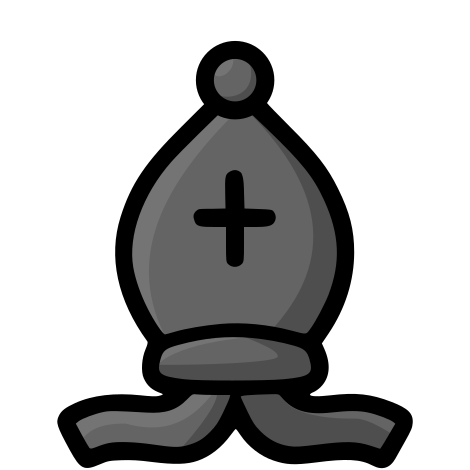
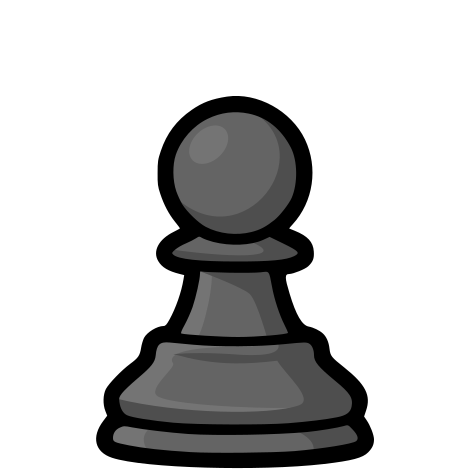
Few pieces and opposite-colored bishops
Each side has a king, bishop, and one pawn. The bishops operate on opposite color complexes and no heavy pieces remain. This board provides the reduced context in which drawing tendencies can be tested, without turning them into a universal rule.
It differs from . In a misevaluation, the player may see all the main moves correctly and still interpret the final position badly. In a miscalculation, the sequence itself contains an omission or an incorrect mental board.
An aims to describe what both sides can achieve with their best play. During a game, , such as how difficult the correct replies are to find, also matter, but they are not the same as objective value. Recording the reasoning and reviewing it through , the systematic study of a recorded think-aloud account, can reveal which factor received too much or too little weight.
Common confusions
Miscalculation
In miscalculation, the mental line is wrong. In misevaluation, the line may be accurate but its final position is judged incorrectly.
View termSources
- 1.Blunders in Modern Play, Intro, Chess.com
- 2.The Winning Academy 21: The Sharpest Middlegame, ChessBase