
'%3e%3cpath%20d='M21.97,16.783C18.592,14.338%2014.595,14.954%2012,17.1C11.344,16.628%2010.011,15.91%209.895,15.621C9.48,14.59%207.341,14.568%207.01,14.882C6.812,15.07%206.83,15.344%206.553,15.331C4.832,15.252%203.708,15.794%201.993,16.774'%20style='fill:none;fill-rule:nonzero;stroke:%2310b981;stroke-width:1.14px;'/%3e%3c/g%3e%3cg%20transform='matrix(1,0,0,2.04091,-14.1682,-22.4853)'%3e%3cpath%20d='M15.074,18.836L15.074,17.423'%20style='fill:none;stroke:%2310b981;stroke-width:0.62px;stroke-linecap:square;stroke-miterlimit:1.5;'/%3e%3c/g%3e%3cg%20transform='matrix(1,0,0,2.04091,6.00754,-22.5274)'%3e%3cpath%20d='M15.074,18.863L15.074,17.423'%20style='fill:none;stroke:%2310b981;stroke-width:0.62px;stroke-linecap:square;stroke-miterlimit:1.5;'/%3e%3c/g%3e%3cg%20transform='matrix(1,0,0,1.10679,-1,-3.20585)'%3e%3cpath%20d='M2,5.5C5.5,3.5%209.5,4%2012,5.8C14.5,4%2018.5,3.5%2022,5.5L22,16.8C18.5,14.8%2014.5,15.3%2012,17.1C9.5,15.3%205.5,14.8%202,16.8L2,5.5Z'%20style='fill:none;fill-rule:nonzero;stroke:%236ee7b7;stroke-width:1.14px;'/%3e%3c/g%3e%3cg%20transform='matrix(1,0,0,1.026,-1,-2.90714)'%3e%3cpath%20d='M12,5.8L12,17.1'%20style='fill:none;fill-rule:nonzero;stroke:%236ee7b7;stroke-width:1.2px;'/%3e%3c/g%3e%3cg%20transform='matrix(0.868549,0,0,1.12022,1.58071,-2.86274)'%3e%3cpath%20d='M8,15.6L8,19.8L6.5,18.5L5,19.8L5,15.6'%20style='fill:none;fill-rule:nonzero;stroke:%236ee7b7;stroke-width:1.2px;'/%3e%3c/g%3e%3cg%20transform='matrix(1,0,0,1,-1,-3.75633)'%3e%3cpath%20d='M5,9C6.467,8.4%207.967,8.5%209.5,9.3'%20style='fill:none;fill-rule:nonzero;stroke:%236ee7b7;stroke-width:1.2px;'/%3e%3c/g%3e%3cg%20transform='matrix(1,0,0,1,-1,-3.75633)'%3e%3cpath%20d='M5,12C6.333,11.467%208.119,11.635%209.119,12.235'%20style='fill:none;fill-rule:nonzero;stroke:%236ee7b7;stroke-width:1.2px;'/%3e%3c/g%3e%3cg%20transform='matrix(0.988254,-0.152823,0.152823,0.988254,6.85356,-2.53705)'%3e%3cpath%20d='M5,12C6.333,11.467%208.119,11.635%209.119,12.235'%20style='fill:none;fill-rule:nonzero;stroke:%236ee7b7;stroke-width:1.2px;'/%3e%3c/g%3e%3cg%20transform='matrix(1,0,0,1,-1,-3.75633)'%3e%3cpath%20d='M14.5,9.3C16.033,8.5%2017.533,8.4%2019,9'%20style='fill:none;fill-rule:nonzero;stroke:%236ee7b7;stroke-width:1.2px;'/%3e%3c/g%3e%3cg%20transform='matrix(1,0,0,1,-1,2.24367)'%3e%3cpath%20d='M5,9C6.467,8.4%207.967,8.5%209.5,9.3'%20style='fill:none;fill-rule:nonzero;stroke:%236ee7b7;stroke-width:1.2px;'/%3e%3c/g%3e%3cg%20transform='matrix(0.999988,0.00496871,-0.00496871,0.999988,-0.955288,2.16055)'%3e%3cpath%20d='M14.5,9.3C16.033,8.5%2017.533,8.4%2019,9'%20style='fill:none;fill-rule:nonzero;stroke:%236ee7b7;stroke-width:1.2px;'/%3e%3c/g%3e%3c/svg%3e)
Explanation
A symmetrical pawn structure has the same basic pattern for both sides. Viewed from each player's perspective, the pawns occupy the same files and corresponding ranks. Symmetry describes only the pawn map; the other pieces do not have to stand on matching squares.
The pawn map is mirrored

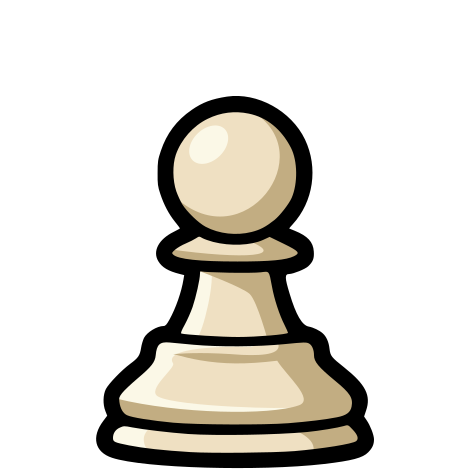
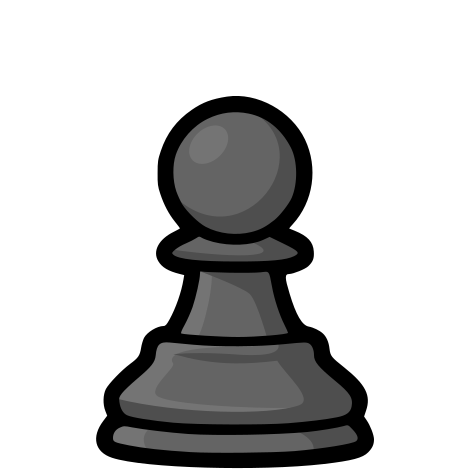

Same files, corresponding relative ranks
The pawn pairs -, -, -, -, and - share files and reflected ranks. The kings on and are not mirrored, so the symmetry belongs only to the pawn map.
Because neither side begins with a unique structural weakness, there are often fewer obvious targets. Symmetry does not mean automatic equality , however. The move, development, piece activity, king safety, and control of an open line may favor one side. Even a small difference in placement can make an apparently balanced position much easier for one player to handle.
Many plans aim to break the symmetry under favorable conditions. An advance, capture, or break may create an open file, weak square, or isolated pawn on only one side. The timing of resolving and causing a is therefore often the central decision.
Common confusions
Symmetrical structure and identical position
The structure compares only pawns. Pieces, the move, and movement rights may still differ.
Symmetry guarantees a draw
No. It reduces some structural differences but does not erase advantages in activity, time, space, or king safety.
Sources
- 1.Pawn Structure Chess Adviser & Replay Lab, ChessWorld.net
- 2.Alexei Shirov: How to crack the Berlin Wall with 5.Re1, ChessBase
- 3.Definitions, Dan Heisman Chess Lessons and Author