
'%3e%3cpath%20d='M21.97,16.783C18.592,14.338%2014.595,14.954%2012,17.1C11.344,16.628%2010.011,15.91%209.895,15.621C9.48,14.59%207.341,14.568%207.01,14.882C6.812,15.07%206.83,15.344%206.553,15.331C4.832,15.252%203.708,15.794%201.993,16.774'%20style='fill:none;fill-rule:nonzero;stroke:%2310b981;stroke-width:1.14px;'/%3e%3c/g%3e%3cg%20transform='matrix(1,0,0,2.04091,-14.1682,-22.4853)'%3e%3cpath%20d='M15.074,18.836L15.074,17.423'%20style='fill:none;stroke:%2310b981;stroke-width:0.62px;stroke-linecap:square;stroke-miterlimit:1.5;'/%3e%3c/g%3e%3cg%20transform='matrix(1,0,0,2.04091,6.00754,-22.5274)'%3e%3cpath%20d='M15.074,18.863L15.074,17.423'%20style='fill:none;stroke:%2310b981;stroke-width:0.62px;stroke-linecap:square;stroke-miterlimit:1.5;'/%3e%3c/g%3e%3cg%20transform='matrix(1,0,0,1.10679,-1,-3.20585)'%3e%3cpath%20d='M2,5.5C5.5,3.5%209.5,4%2012,5.8C14.5,4%2018.5,3.5%2022,5.5L22,16.8C18.5,14.8%2014.5,15.3%2012,17.1C9.5,15.3%205.5,14.8%202,16.8L2,5.5Z'%20style='fill:none;fill-rule:nonzero;stroke:%236ee7b7;stroke-width:1.14px;'/%3e%3c/g%3e%3cg%20transform='matrix(1,0,0,1.026,-1,-2.90714)'%3e%3cpath%20d='M12,5.8L12,17.1'%20style='fill:none;fill-rule:nonzero;stroke:%236ee7b7;stroke-width:1.2px;'/%3e%3c/g%3e%3cg%20transform='matrix(0.868549,0,0,1.12022,1.58071,-2.86274)'%3e%3cpath%20d='M8,15.6L8,19.8L6.5,18.5L5,19.8L5,15.6'%20style='fill:none;fill-rule:nonzero;stroke:%236ee7b7;stroke-width:1.2px;'/%3e%3c/g%3e%3cg%20transform='matrix(1,0,0,1,-1,-3.75633)'%3e%3cpath%20d='M5,9C6.467,8.4%207.967,8.5%209.5,9.3'%20style='fill:none;fill-rule:nonzero;stroke:%236ee7b7;stroke-width:1.2px;'/%3e%3c/g%3e%3cg%20transform='matrix(1,0,0,1,-1,-3.75633)'%3e%3cpath%20d='M5,12C6.333,11.467%208.119,11.635%209.119,12.235'%20style='fill:none;fill-rule:nonzero;stroke:%236ee7b7;stroke-width:1.2px;'/%3e%3c/g%3e%3cg%20transform='matrix(0.988254,-0.152823,0.152823,0.988254,6.85356,-2.53705)'%3e%3cpath%20d='M5,12C6.333,11.467%208.119,11.635%209.119,12.235'%20style='fill:none;fill-rule:nonzero;stroke:%236ee7b7;stroke-width:1.2px;'/%3e%3c/g%3e%3cg%20transform='matrix(1,0,0,1,-1,-3.75633)'%3e%3cpath%20d='M14.5,9.3C16.033,8.5%2017.533,8.4%2019,9'%20style='fill:none;fill-rule:nonzero;stroke:%236ee7b7;stroke-width:1.2px;'/%3e%3c/g%3e%3cg%20transform='matrix(1,0,0,1,-1,2.24367)'%3e%3cpath%20d='M5,9C6.467,8.4%207.967,8.5%209.5,9.3'%20style='fill:none;fill-rule:nonzero;stroke:%236ee7b7;stroke-width:1.2px;'/%3e%3c/g%3e%3cg%20transform='matrix(0.999988,0.00496871,-0.00496871,0.999988,-0.955288,2.16055)'%3e%3cpath%20d='M14.5,9.3C16.033,8.5%2017.533,8.4%2019,9'%20style='fill:none;fill-rule:nonzero;stroke:%236ee7b7;stroke-width:1.2px;'/%3e%3c/g%3e%3c/svg%3e)
Explanation
A positional bind is a stable grip on squares or pawn advances the opponent needs in order to activate the position. It rarely wins a piece or pawn at once. Instead, it reduces available space, meaning the squares where pieces can maneuver, limits their routes, and makes pawn breaks difficult. A pawn break is an advance intended to challenge the enemy pawn arrangement and open lines.
Pawns often form the framework because their control is persistent. Pieces reinforce the grip, stop freeing attempts, and occupy squares the opponent must concede. The best-known example is the Maróczy Bind, where two White pawns control central squares and obstruct Black's freeing advances. It illustrates the idea, but a bind is not limited to one opening.
The Maróczy framework
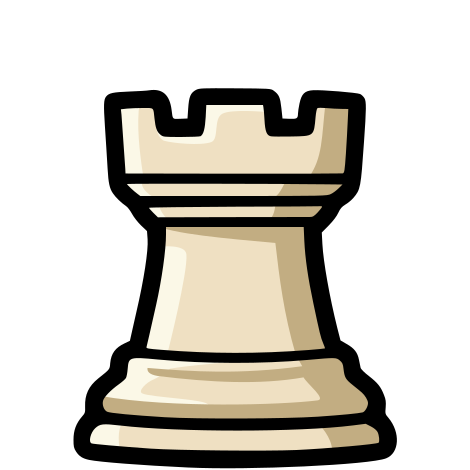

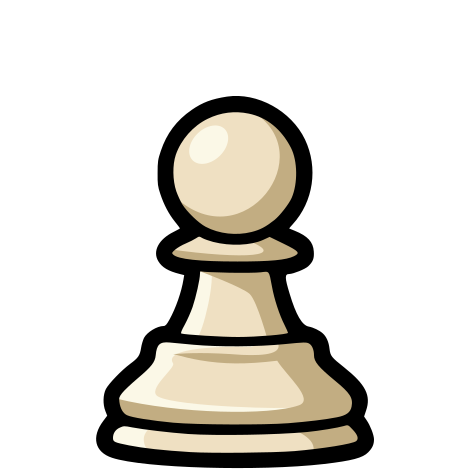
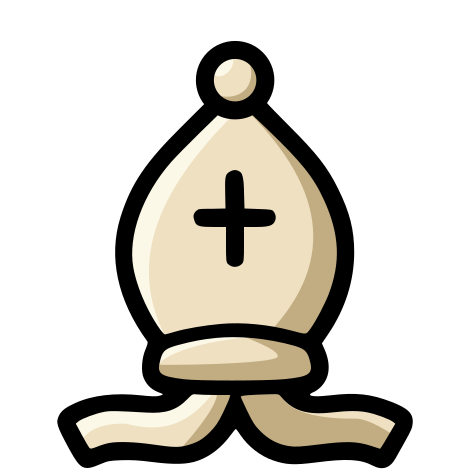

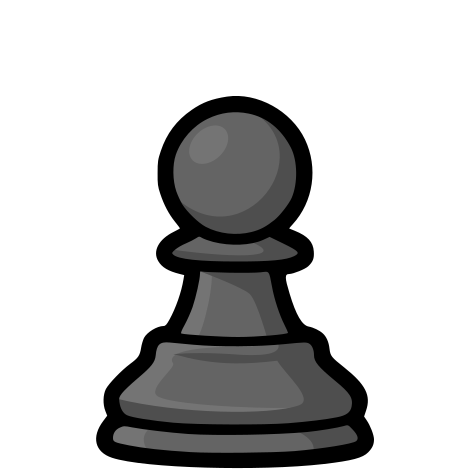


A stable network over the freeing breaks
and control , while the knight on reinforces and covers . If Black attempts the freeing advances, they enter squares that are already controlled.
Maintaining and breaking the grip
- The side applying the bind improves pieces without allowing a freeing break.
- Pressure may be increased through , meaning accumulated attacks along a vertical line, or focused on one square until the opponent concedes something.
- The restricted side tries to exchange restraining pieces, prepare a break with several pieces, or create active threats away from the bind.
- Deliberately giving up a pawn may be justified if it opens lines and restores enough activity.
A bind is not an automatic win. The side controlling more territory must ensure that its pawns are not too advanced to receive support and that its pieces have useful routes. One successful break or a series of favorable exchanges may dissolve the grip. more often describes one piece with no useful squares, while a bind restrains a broader position.
Space that can still be opened
Space that a break can still challenge
The pawns on and occupy more territory, but ... remains viable and would attack . While that break exists, the structure is not a stable bind.
Common confusions
Bind and pin
A pin is a tactical relation in which a piece cannot move without exposing something more valuable. A bind restricts a zone or position through lasting control of squares and breaks.
Bind and blockade
A blockade directly stops a pawn or one line. A bind may include blockades, but it covers several squares and the opponent's broader freeing plans.
Sources
- 1.Glossary of chess, Wikipedia
- 2.Maróczy Bind, Wikipedia
- 3.Maroczy Bind, Chess.com