
'%3e%3cpath%20d='M21.97,16.783C18.592,14.338%2014.595,14.954%2012,17.1C11.344,16.628%2010.011,15.91%209.895,15.621C9.48,14.59%207.341,14.568%207.01,14.882C6.812,15.07%206.83,15.344%206.553,15.331C4.832,15.252%203.708,15.794%201.993,16.774'%20style='fill:none;fill-rule:nonzero;stroke:%2310b981;stroke-width:1.14px;'/%3e%3c/g%3e%3cg%20transform='matrix(1,0,0,2.04091,-14.1682,-22.4853)'%3e%3cpath%20d='M15.074,18.836L15.074,17.423'%20style='fill:none;stroke:%2310b981;stroke-width:0.62px;stroke-linecap:square;stroke-miterlimit:1.5;'/%3e%3c/g%3e%3cg%20transform='matrix(1,0,0,2.04091,6.00754,-22.5274)'%3e%3cpath%20d='M15.074,18.863L15.074,17.423'%20style='fill:none;stroke:%2310b981;stroke-width:0.62px;stroke-linecap:square;stroke-miterlimit:1.5;'/%3e%3c/g%3e%3cg%20transform='matrix(1,0,0,1.10679,-1,-3.20585)'%3e%3cpath%20d='M2,5.5C5.5,3.5%209.5,4%2012,5.8C14.5,4%2018.5,3.5%2022,5.5L22,16.8C18.5,14.8%2014.5,15.3%2012,17.1C9.5,15.3%205.5,14.8%202,16.8L2,5.5Z'%20style='fill:none;fill-rule:nonzero;stroke:%236ee7b7;stroke-width:1.14px;'/%3e%3c/g%3e%3cg%20transform='matrix(1,0,0,1.026,-1,-2.90714)'%3e%3cpath%20d='M12,5.8L12,17.1'%20style='fill:none;fill-rule:nonzero;stroke:%236ee7b7;stroke-width:1.2px;'/%3e%3c/g%3e%3cg%20transform='matrix(0.868549,0,0,1.12022,1.58071,-2.86274)'%3e%3cpath%20d='M8,15.6L8,19.8L6.5,18.5L5,19.8L5,15.6'%20style='fill:none;fill-rule:nonzero;stroke:%236ee7b7;stroke-width:1.2px;'/%3e%3c/g%3e%3cg%20transform='matrix(1,0,0,1,-1,-3.75633)'%3e%3cpath%20d='M5,9C6.467,8.4%207.967,8.5%209.5,9.3'%20style='fill:none;fill-rule:nonzero;stroke:%236ee7b7;stroke-width:1.2px;'/%3e%3c/g%3e%3cg%20transform='matrix(1,0,0,1,-1,-3.75633)'%3e%3cpath%20d='M5,12C6.333,11.467%208.119,11.635%209.119,12.235'%20style='fill:none;fill-rule:nonzero;stroke:%236ee7b7;stroke-width:1.2px;'/%3e%3c/g%3e%3cg%20transform='matrix(0.988254,-0.152823,0.152823,0.988254,6.85356,-2.53705)'%3e%3cpath%20d='M5,12C6.333,11.467%208.119,11.635%209.119,12.235'%20style='fill:none;fill-rule:nonzero;stroke:%236ee7b7;stroke-width:1.2px;'/%3e%3c/g%3e%3cg%20transform='matrix(1,0,0,1,-1,-3.75633)'%3e%3cpath%20d='M14.5,9.3C16.033,8.5%2017.533,8.4%2019,9'%20style='fill:none;fill-rule:nonzero;stroke:%236ee7b7;stroke-width:1.2px;'/%3e%3c/g%3e%3cg%20transform='matrix(1,0,0,1,-1,2.24367)'%3e%3cpath%20d='M5,9C6.467,8.4%207.967,8.5%209.5,9.3'%20style='fill:none;fill-rule:nonzero;stroke:%236ee7b7;stroke-width:1.2px;'/%3e%3c/g%3e%3cg%20transform='matrix(0.999988,0.00496871,-0.00496871,0.999988,-0.955288,2.16055)'%3e%3cpath%20d='M14.5,9.3C16.033,8.5%2017.533,8.4%2019,9'%20style='fill:none;fill-rule:nonzero;stroke:%236ee7b7;stroke-width:1.2px;'/%3e%3c/g%3e%3c/svg%3e)
Explanation
A knight ending is a position in which knights are the main pieces left besides the kings and pawns. A knight reaches only nearby squares with each jump, so it may need several turns to move from one wing to the other. This limited speed can make a distant pawn race more dangerous than it would be in a bishop ending.
The front shifts wings

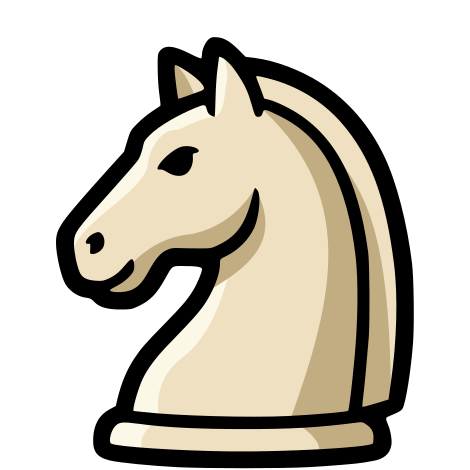

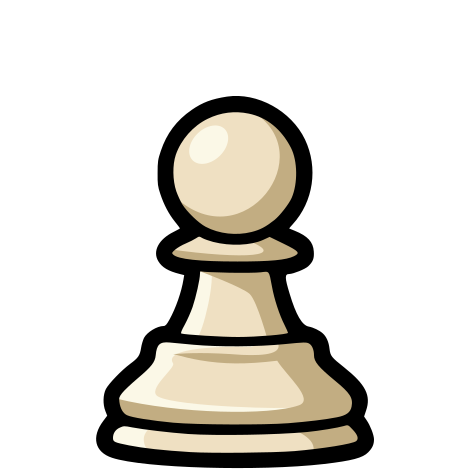

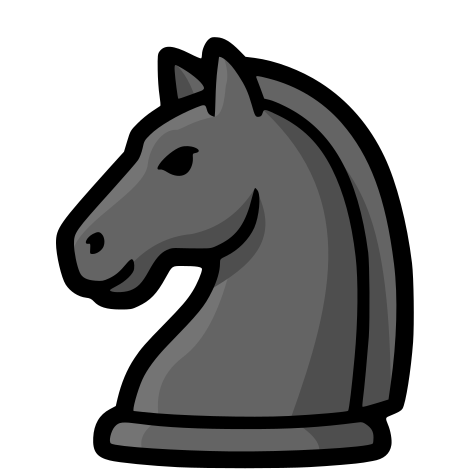
is far in knight moves
The black pawn has just reached and is its next advance square. From , the white knight needs four legal jumps to reach ; visual proximity does not replace that real distance.
A knight is often an effective blockader. It can stand in front of a passed pawn, meaning one with no enemy pawns ahead in its vertical column or the neighboring columns, stop its advance, and still attack other squares. Its value depends heavily on placement. A knight near the center can control up to eight squares, while a knight near the edge controls fewer and takes longer to return to the action.
Blocking without becoming passive
performs two jobs
The white knight occupies , immediately in front of the black pawn on . From there it also attacks , so the blockade is not its only function.
Knight endings share several ideas with . The kings must become active. , a relationship that uses the kings' spacing and move order to make one king yield ground, may decide whether a king can enter. A distant passed pawn may also pull a knight away from the other wing.
Knights add checks, attacks on two targets at once, and possible deliberate knight sacrifices to stop or enable promotion. Simply counting the pawn moves is therefore not enough.
What to compare
- Each knight's real distance from the critical area.
- Whether a stable central square is available for the knight.
- The activity of both kings and which one can attack pawns first.
- Whether a knight must be sacrificed for a pawn that is close to promotion.
Common confusions
Knight ending and king plus knight versus king
Knight ending usually means a position with pawns or a knight for each side. King and one knight versus king cannot reach checkmate through any legal sequence and is a dead-position draw.
Knight ending and bishop ending
A knight is slow and can jump over pieces; a bishop has long range but remains tied to one square color. A therefore requires a different evaluation of diagonals and square colors.
View termSources
- 1.Minor piece endgames, Chess Strategy Online
- 2.Knight - Chess Terms, Chess.com
- 3.FIDE Laws of Chess taking effect from 1 January 2023, FIDE